Sociocracy 3.0
An S3 governance workflow to turn tensions into consented decisions — proposals, policies, experiments, and follow-through in one board.
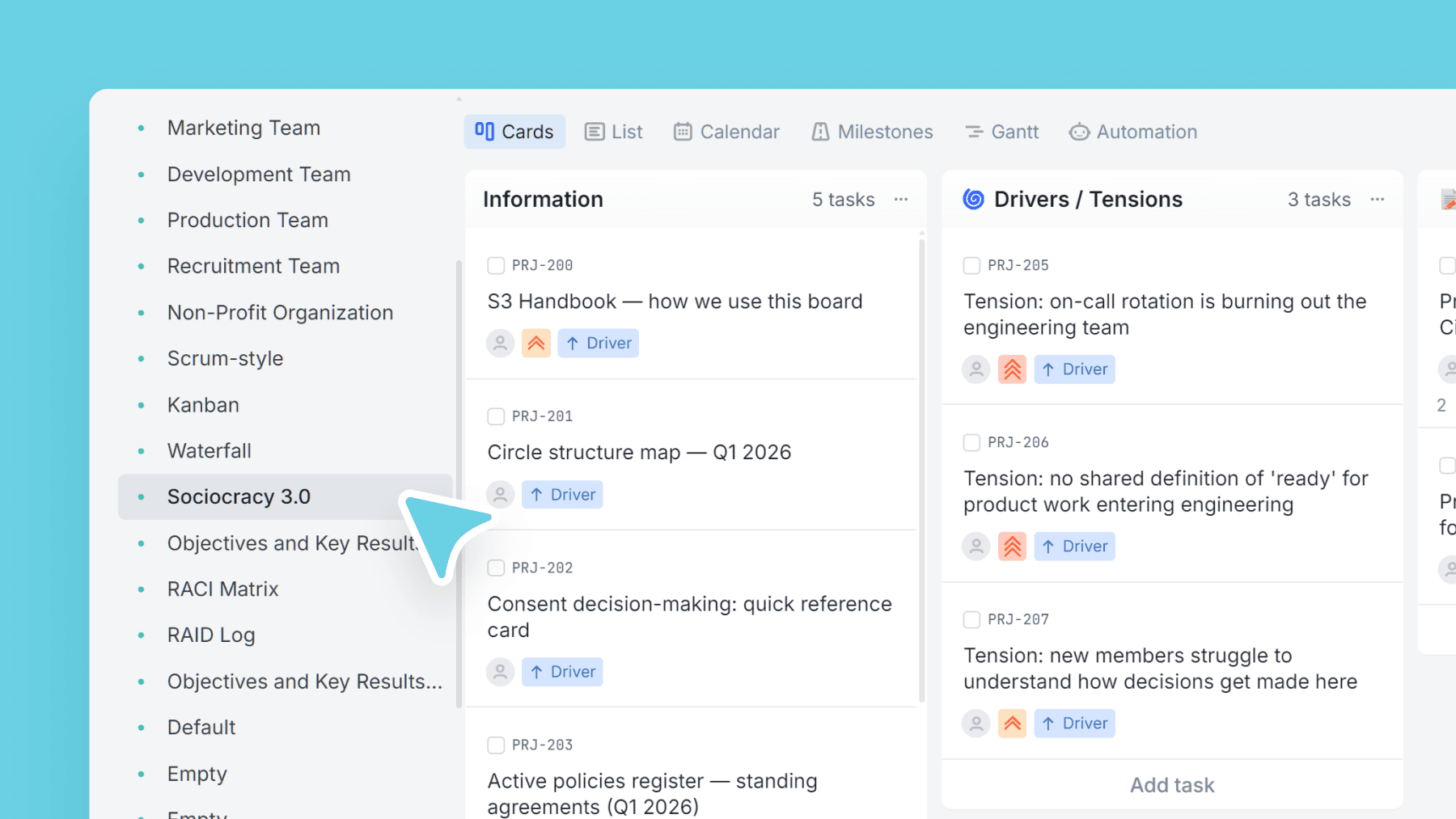
About this template
This board supports Sociocracy 3.0 decision making: work moves forward when there are no reasoned objections — inclusive, but not stuck.
Capture drivers/tensions, draft proposals, run them through consent review, and then track implementation as projects, policies, or time-boxed experiments.
Custom fields keep governance clean: link proposals to related drivers, assign a circle, define "done", and state expected outcomes so decisions stay measurable.
What is Sociocracy 3.0?
Sociocracy 3.0, or S3, is a consent-based governance framework for self-organizing teams. Unlike standard voting, decisions do not require full consensus. A proposal passes when no one raises a reasoned, paramount objection.
The process starts with a Driver: a recognized tension or need that justifies change. From there, the team drafts a Proposal, runs it through Consent Review, and tracks implementation as a Project, Policy, or time-boxed Experiment.
S3 is used by cooperatives, flat organizations, and agile teams that want structured decision-making without top-down authority.
What’s inside
Columns included
Task types
Custom fields
Key features
- Driver/Tension → Proposal → Consent flow
- Clear separation of proposals, policies, and experiments
- Circle ownership + Definition of Done baked in
- Retrospective archive to preserve learnings
- Parked/Rejected lanes for transparency
Who is this template for?
- Self-organizing teams
- S3 / Holacracy practitioners
- Cooperatives and communities
- Teams improving governance without bureaucracy
- Decision-heavy orgs
How to use this template
Use this board to turn tensions into proposals, proposals into consented decisions, and decisions into accountable follow-through.
Step 1
Capture the tension behind the work
Start with Information and Drivers / Tensions to record the reason a topic exists before discussion turns into solutioning. This helps the team stay anchored in the real driver instead of debating abstract ideas.
Step 2
Run proposals through consent review
Move ideas into Proposals and Consent Review, using fields like Related driver(s), Circle, Definition of done, and Expected outcome to make each proposal concrete enough for consent-based decision making.
Step 3
Track agreement into implementation
Once something is agreed, move it through Agreed, In Progress, and Ready for Review as a Project, Policy, or Experiment. Use Retrospective Archive to preserve learnings and Parked / Rejected to keep transparency around decisions that did not move forward.
Frequently asked questions
Related templates

RACI matrix
Clarify roles and responsibilities across project phases — assign Responsible, Accountable, Consulted, and Informed for every deliverable.

Scrum
A ready-to-run Scrum board with ceremonies, sprint tracking, WIP limits, and engineering task categories.

Kanban
Classic Kanban flow with a strict WIP limit — visualize work, reduce bottlenecks, and ship continuously.